Privacy-Aware Eye Tracking Using Differential Privacy
Julian Steil, Inken Hagestedt, Michael Xuelin Huang, Andreas Bulling
Proc. ACM International Symposium on Eye Tracking Research and Applications (ETRA), pp. 1--9, 2019.
AbstractLinksBibTeXProject Best Paper Award
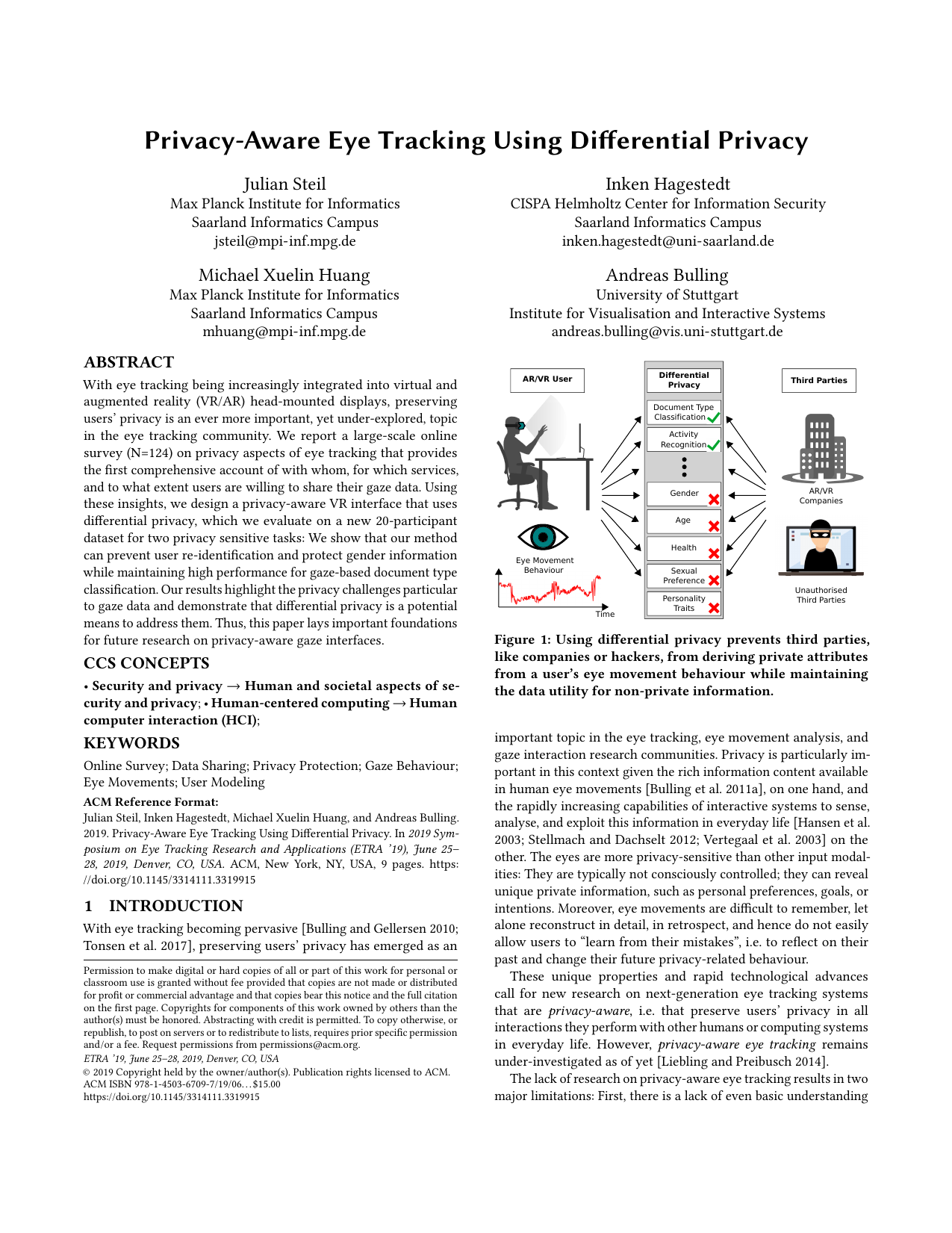
With eye tracking being increasingly integrated into virtual and augmented reality (VR/AR) head-mounted displays, preserving users' privacy is an ever more important, yet under-explored, topic in the eye tracking community. We report a large-scale online survey (N=124) on privacy aspects of eye tracking that provides the first comprehensive account of with whom, for which services, and to which extent users are willing to share their gaze data. Using these insights, we design a privacy-aware VR interface that uses differential privacy, which we evaluate on a new 20-participant dataset for two privacy sensitive tasks: We show that our method can prevent user re-identification and protect gender information while maintaining high performance for gaze-based document type classification. Our results highlight the privacy challenges particular to gaze data and demonstrate that differential privacy is a potential means to address them. Thus, this paper lays important foundations for future research on privacy-aware gaze interfaces.
@inproceedings{steil19_etra_2,
title = {Privacy-Aware Eye Tracking Using Differential Privacy},
author = {Julian Steil and Inken Hagestedt and Michael Xuelin Huang and Andreas Bulling},
year = {2019},
booktitle = {Proc. ACM International Symposium on Eye Tracking Research and Applications (ETRA)},
pages = {1--9},
doi = {10.1145/3314111.3319915},
}
PrivacEye: Privacy-Preserving Head-Mounted Eye Tracking Using Egocentric Scene Image and Eye Movement Features
Julian Steil, Marion Koelle, Wilko Heuten, Susanne Boll, Andreas Bulling
Proc. ACM International Symposium on Eye Tracking Research and Applications (ETRA), pp. 1--10, 2019.
AbstractLinksBibTeXProject Best Video Award
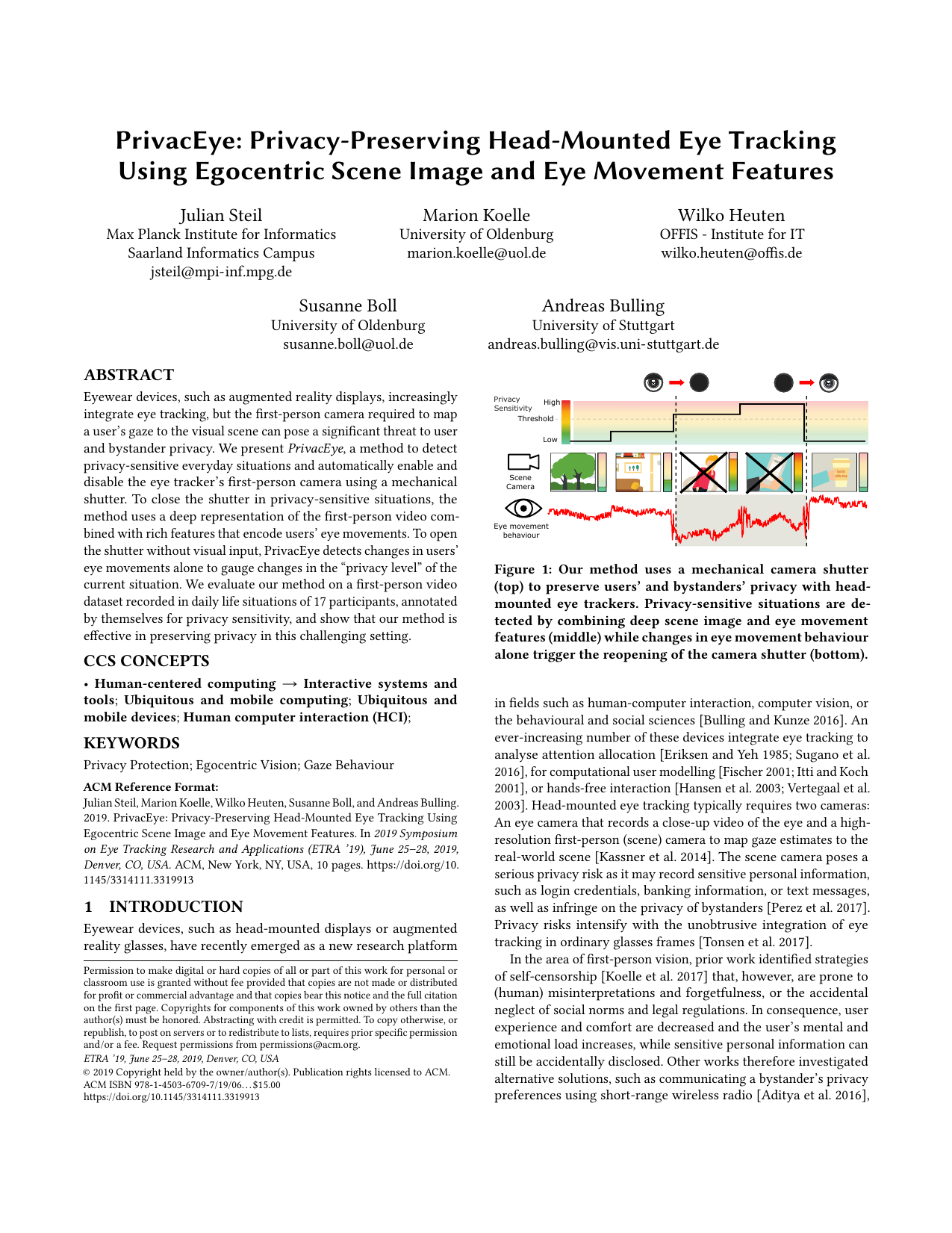
Eyewear devices, such as augmented reality displays, increasingly integrate eye tracking but the first-person camera required to map a user's gaze to the visual scene can pose a significant threat to user and bystander privacy. We present PrivacEye, a method to detect privacy-sensitive everyday situations and automatically enable and disable the eye tracker's first-person camera using a mechanical shutter. To close the shutter in privacy-sensitive situations, the method uses a deep representation of the first-person video combined with rich features that encode users' eye movements. To open the shutter without visual input, PrivacEye detects changes in users' eye movements alone to gauge changes in the "privacy level" of the current situation. We evaluate our method on a first-person video dataset recorded in daily life situations of 17 participants, annotated by themselves for privacy sensitivity, and show that our method is effective in preserving privacy in this challenging setting.
@inproceedings{steil19_etra,
title = {PrivacEye: Privacy-Preserving Head-Mounted Eye Tracking Using Egocentric Scene Image and Eye Movement Features},
author = {Julian Steil and Marion Koelle and Wilko Heuten and Susanne Boll and Andreas Bulling},
year = {2019},
booktitle = {Proc. ACM International Symposium on Eye Tracking Research and Applications (ETRA)},
pages = {1--10},
doi = {10.1145/3314111.3319913},
video = {https://www.youtube.com/watch?v=Gy61255F8T8},
}